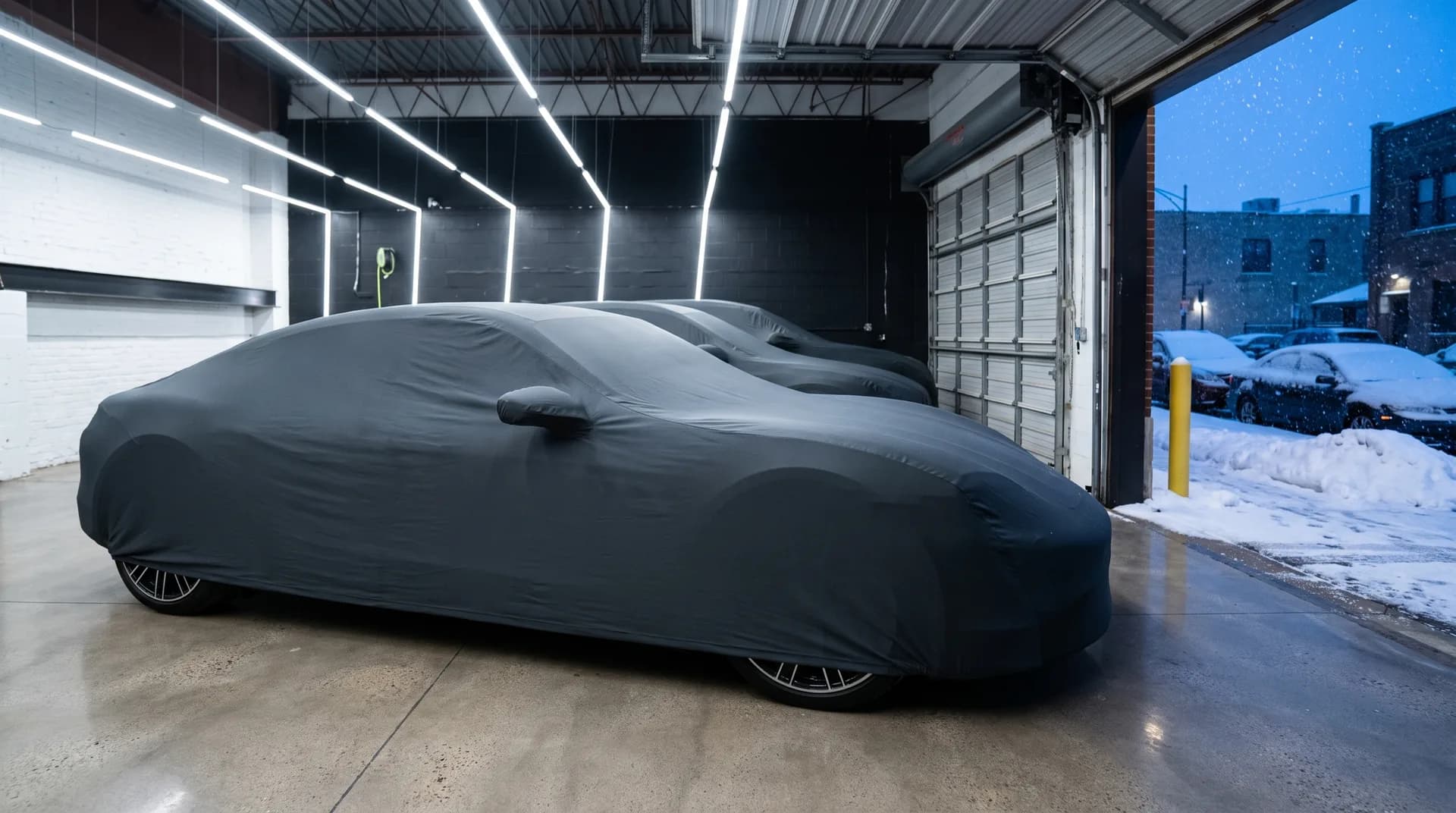
Winter Vehicle Storage: How to Store a Car for Winter
How to store a car for winter in Chicago: salt wash, oil, fuel, battery, tires, mice, insurance, and a spring wake-up checklist.
- October 14, 2026
- Carrectly Auto Care
- 13 min read
Picture a car that spends December to March on a Logan Square side street. It gets dug out twice, moved once for the plow, and sprayed with salty slush every time a truck rolls by. In April the battery is dead. A mouse has built a nest in the air filter box. The doors wear a white crust of road salt. None of that is bad luck. It is what a Chicago winter does to a car that just sits.
Winter vehicle storage is the fix, and it is not hard. It is a list. Below is the list we follow at our West Town shop, step by step. We also cover the Chicago parts most guides skip: the overnight parking ban, our damp lake air, and the paperwork that comes due while the car sleeps.
Key takeaways
- Where the car sits matters more than any product you buy
- Wash off the salt, change the oil, and fill the tank before it parks
- Keep the battery on a tender, add air to the tires, and skip the parking brake
- Block mice with steel wool and an empty cabin, not just peppermint
- Call your insurer and check your plate date before you store, not after
How do you store a car for winter?
Wash it, change the oil, fill the tank and add stabilizer, and keep the battery charged. Add a few psi to the tires, leave the parking brake off, block mice, and control moisture with a desiccant and a breathable cover. Then call your insurer. Most of all, park it somewhere dry and off the street.
First decide where the car will sit
Most guides start with fuel and tires. We start with the parking spot, because in Chicago it decides half the outcome. A car on the street fights the city all winter. A car indoors just waits.
The overnight parking ban. From December 1 to April 1, the city bans parking on 107 miles of main streets from 3 a.m. to 7 a.m. It applies whether it snows or not. A second ban covers 500 more miles of streets once two inches of snow fall. A stored car does not move, so a stored car on the wrong street gets towed.
Plows and salt. Even on a legal side street, plows bury the car and passing traffic coats it in brine. Salt sits in the seams for months with nothing to rinse it off.
Damp lake air. Air off Lake Michigan stays damp, and our winters swing above and below freezing. Each thaw puts water on cold metal and into door seals. Then it freezes again. A car under a snowbank lives in that cycle all season.
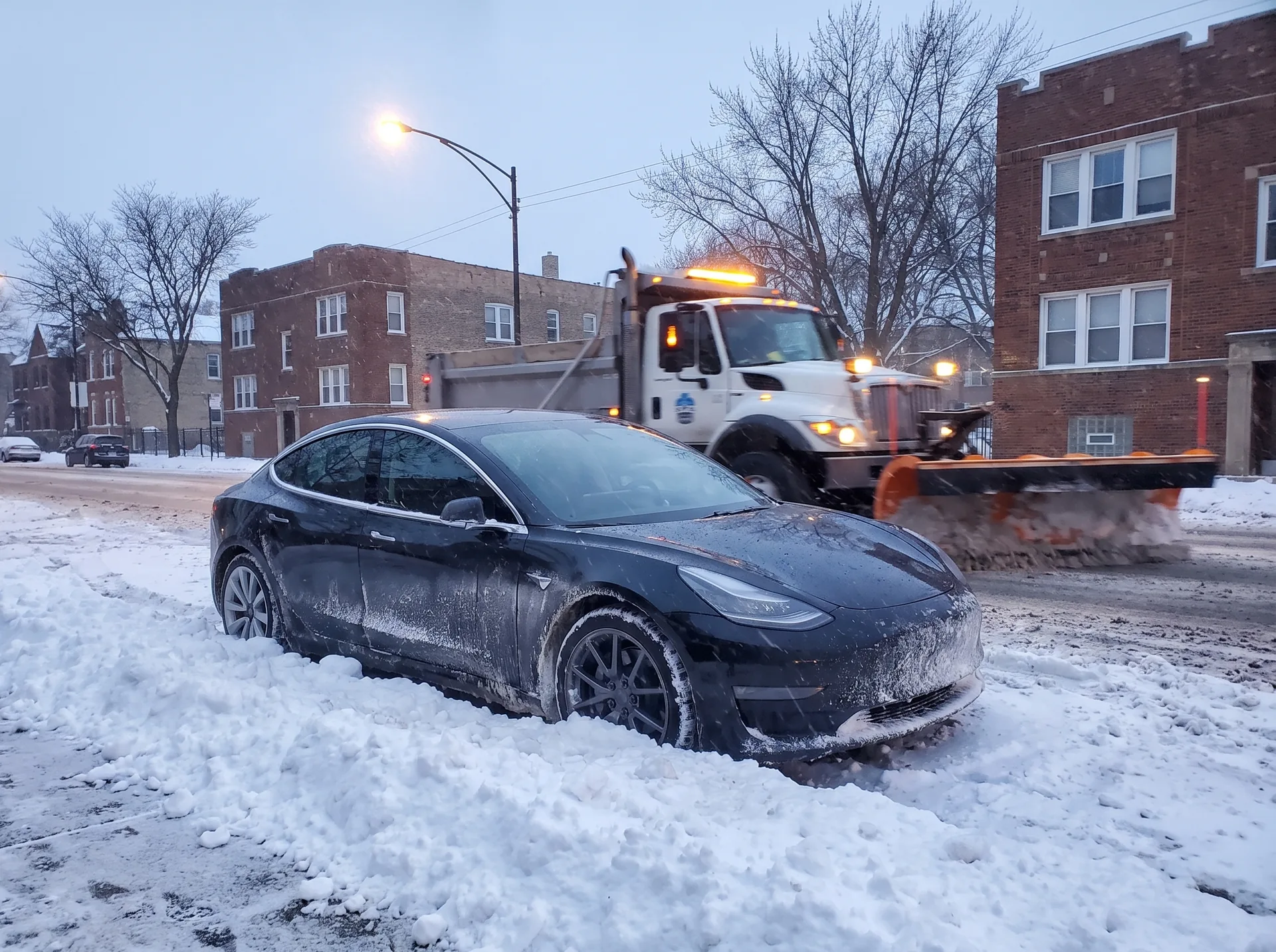
$150 tow + $60 ticket + $25 a day. The minimum cost of a car left on a Chicago overnight ban street between 3 and 7 a.m., December 1 to April 1, snow or no snow.
Street
- Parking ban and plows: must stay off ban streets 3 to 7 a.m. and gets buried
- Road salt: sprayed by every passing car
- Moisture: snow, thaw, refreeze on the car
- Battery: no outlet, cold drains it
- Mice: open season in the engine bay
- Cost: free until a tow
Home garage
- Parking ban and plows: no issue
- Road salt: only what you drive in
- Moisture: better, but often damp
- Battery: fine if you have an outlet
- Mice: possible, garages draw them
- Cost: what you already pay
Climate-controlled storage
- Parking ban and plows: no issue
- Road salt: none once it is washed
- Moisture: kept in check
- Battery: checked for you
- Mice: inspected on a routine
- Cost: daily, weekly, or monthly rate
Step 1: Wash, wax, and rinse the salt off the undercarriage
Never store a dirty car. Road salt and brine keep working on paint and metal for as long as they sit there. Bird droppings and grime do the same to clear coat. Wash the car well, dry it fully, and put on a coat of wax or sealant. The wax gives the paint a barrier for the months it cannot be touched.
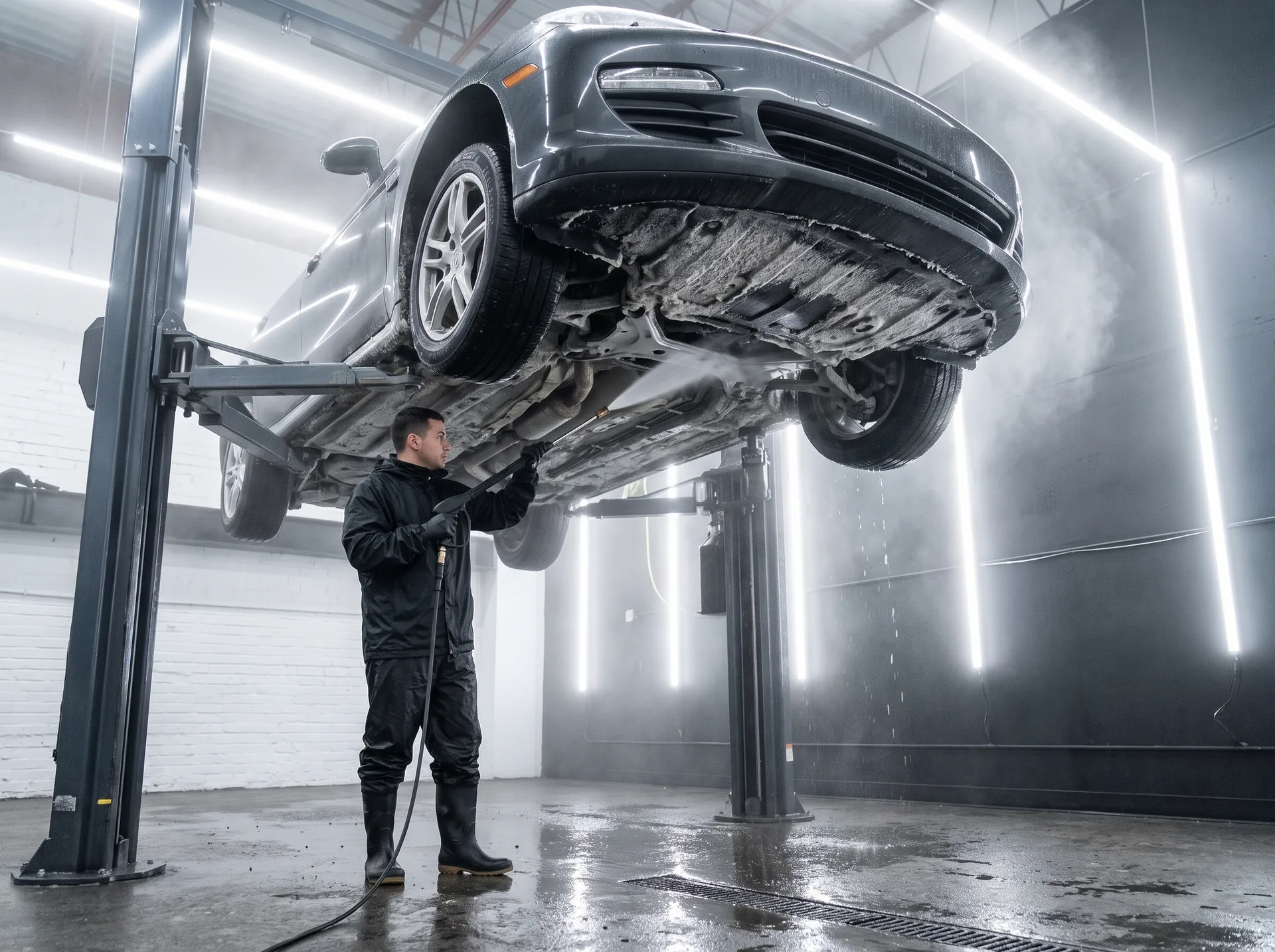
The paint is the easy part. The real salt hides underneath: on frame rails, brake lines, the backs of the bumpers, and inside the rocker panels. A hose in the driveway does not reach it. A proper undercarriage power wash soaks the grime loose, blasts it off, and rinses it clean before the car goes to sleep.
Do the cabin too. Vacuum the floors, take out the mats to dry, and remove every crumb. That last part matters again in Step 5.
Step 2: Fresh oil, a full tank, and the right coolant mix
Change the oil before storage, not after. Used oil carries acids, fuel, and moisture from every drive. Left in the engine for months, that mix sits on metal parts. Fresh oil gives the engine clean protection while it waits. If you are close to your next change anyway, do it now.
Fill the tank. A full tank leaves less room for damp air, so less water can condense inside. Fill it close to the top, and leave a little space for the fuel to expand.
Add fuel stabilizer, and know why. Here is the honest part. The U.S. Department of Energy says gasoline in a sealed container stays in spec for at least a year. So stabilizer is not magic, and fuel will not spoil in one Chicago winter. But a car tank is not a sealed can, and most pump gas has ethanol in it. Stabilizer costs a few dollars. We add it, then drive ten minutes so it reaches the fuel lines.
Check the coolant mix. Coolant keeps the engine from freezing and cracking. Most cars run a 50/50 mix of coolant and water. If someone topped it off with plain water, the freeze point rises. A shop can test it in a minute. In a Chicago cold snap, that minute matters.
Step 3: Battery tender or disconnect?
The battery is the part most likely to fail in storage. Modern cars draw a little power even when off, and cold slows the battery down. A few weeks is fine. A few months usually is not.
Use a battery tender if you have an outlet. A tender, also called a maintainer, watches the battery and adds charge only when it needs it. It is not the same as an old trickle charger, which keeps pushing current and can overcharge. A tender is the best choice for a garage.
Disconnect if you do not. No outlet? Take the negative cable off the battery. That stops the slow drain from the car. The battery still loses some charge on its own, so check it midwinter if you can. Expect to reset the clock and radio in spring, and some cars need a window or key relearn.
Leaving the car on the street with no power for months? Take the battery out, charge it, and keep it somewhere above freezing. A charged battery handles cold far better than a flat one.
Step 4: More air in the tires, and no parking brake
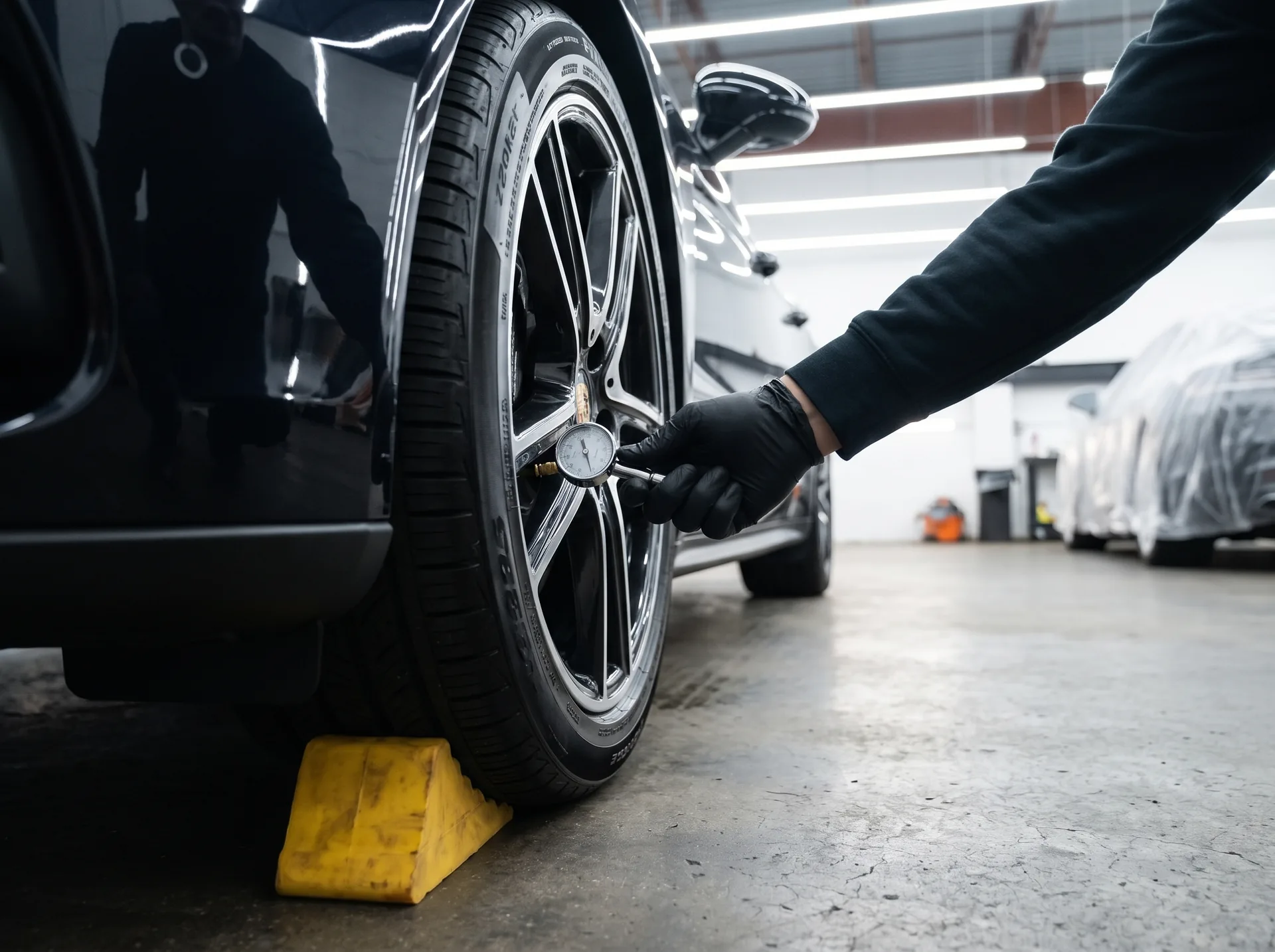
Add a few psi. Tires lose pressure over time, and they lose more in the cold. Fill them a few psi above the number on the door jamb. Never go past the max printed on the sidewall. Write yourself a note to set them back in spring.
Fight flat spots. A tire that holds the same spot for months can take a set and thump for the first few miles. More air helps. So does rolling the car a foot or two every few weeks, if you can get to it. Running winter tires on your daily driver? Your summer set needs a dry home too, and our wheel and tire storage keeps it in a climate-controlled room.
Leave the parking brake off. In damp cold, brake pads can stick to the rotors, and cables can seize. Put an automatic in Park, or a manual in gear, and set wheel chocks against the tires instead. Chocks are cheap and they never rust in place.
Rather not do all this in a cold garage? We pick the car up and store it for you. See our car storage
Step 5: Keep the mice out
A quiet car is a warm, dry shelter with soft seat foam and wires to chew. Mice need only a small gap to get in. Your job is to close the doors they use and give them no reason to come.
Plug the openings with steel wool. Push a wad of fine steel wool into the exhaust tip and into the air intake opening. Mice do not like to chew through it. Then hang a bright tag on the steering wheel that says what you plugged. Starting the car with the exhaust blocked is a mistake you only make once.
Leave nothing to eat. No snacks, wrappers, gum, or dog treats. Not in the cabin, not in the trunk. Food is what turns a curious mouse into a tenant.
Peppermint is a bonus, not a plan. Many owners put peppermint oil on cotton balls under the hood. It smells nice and it may help a little. But NC State Extension says odor repellents are not a reliable way to stop rodents, and the oils fade fast. Use it on top of steel wool and a clean cabin, never instead.
Step 6: Control moisture with a desiccant and the right cover
Damp air is the quiet enemy of a stored car. It fogs the glass, feeds mildew in the carpet, and finds bare metal. In our lake climate, a closed cabin can smell musty by March.
Put a desiccant inside. A moisture absorber tub on the floor of the cabin, and one in the trunk, pulls water from the air. Check them midwinter. If a tub is full of water, swap it.
Use a breathable cover. A good car cover is soft fabric that lets moisture escape. A plastic tarp is the opposite. It traps water against the paint and can rub the finish every time the wind moves it. Only cover a clean, fully dry car, or you seal the dirt in with it.
Outside on the street, a cover can freeze to the car or blow off in a storm. That is one more reason indoor storage wins in Chicago.
Step 7: Sort out insurance, registration, and emissions
Do not cancel your insurance. A stored car can still be stolen, catch fire, or get hit by hail or a falling branch. The part of your policy that pays for that is called "comp" by most insurers. Ask about a comp-only plan, often called storage or parked car coverage. It can cost much less than a full policy.
Know the Illinois rule first. Illinois requires liability coverage of at least $25,000 per person, $50,000 per accident, and $20,000 for property damage on cars that are on the road. If your car stays registered, or you have a loan, ask your agent and lender what you can drop. And put full coverage back before the first spring drive.
Check your plate date. In the Chicago area, most gas cars four years and older need an emissions test every two years, in the month the plates expire. If that month falls in February or March, the car is stored when the test is due. You can test up to four months early, so do it in the fall before the car parks. Miss it, and the plates cannot be renewed.
Or skip the list and let us store it
Some owners like doing all of this. Many would rather not spend a December Saturday on a cold garage floor. That is why we offer car storage.
Your car sits indoors in a climate-controlled space, away from the parking ban and the plows. The building has surveillance, alarms, and controlled access. While it is stored, we run routine checks on tire pressure, fluid levels, and battery health. Plans run by the day, week, or month.
We can pick the car up and bring it back almost anywhere in Chicago at no charge. We can also handle the wash, the undercarriage rinse, and the oil change before it goes in.
The spring wake-up checklist
1. Pull the steel wool and the reminder tag
Check the exhaust tip and the air intake. Take out every wad you put in, then remove the tag from the steering wheel.
2. Look for signs of mice
Open the hood and check the air filter box, the cabin air filter, and the engine cover for nests, droppings, or chewed wires. If you find a nest, wear gloves and a mask to clean it out.
3. Wake up the battery
Unplug the tender or reconnect the negative cable. If the car cranks slowly, charge the battery before you try again.
4. Set the tires back to normal
Let the extra air out to the number on the door jamb. Look for cracks, bulges, or a soft tire.
5. Check the fluids
Check the oil and coolant levels, and look under the car for fresh drips on the floor.
6. Remove the chocks and test the brakes
Roll forward slowly and brake a few times. A light scrape from surface rust on the rotors should clear after a few stops. If it does not, have the brakes checked.
7. Air out the cabin
Take out the desiccant tubs and the cover. Open the doors for a while and check the carpet for damp or a musty smell.
8. Restore your insurance and check your plates
Put full coverage back before the first drive, and make sure the registration sticker is current.
9. Take it easy on the first drive
Drive gently for the first few miles while the oil and tires warm up. Then wash off the winter dust and book a quick inspection.
Frequently Asked Questions
1. How long can a car sit without being driven?
A few weeks is usually fine. Past a month, the battery is the first thing to go, and tires can start to flat spot. If the car will sit all winter, prep it: charge the battery, add air to the tires, fill the tank, and block mice.
2. Should I start my stored car every week?
No. A short idle does not fully charge the battery or warm the oil enough to burn off moisture. It can leave things worse. Either take a real drive of 20 minutes or more, or leave the car stored with a battery tender.
3. Can I leave my car on the street in Chicago all winter?
You can on streets without the ban, but it is risky. From December 1 to April 1, parking is banned from 3 to 7 a.m. on 107 miles of main streets, snow or not. A tow costs at least $150, plus a $60 ticket and $25 a day. Plows and salt add damage on any street.
4. Do I need insurance on a stored car in Illinois?
Keep at least comp coverage, the part of a policy that pays for theft, fire, and hail, because a stored car can still be stolen or damaged. Illinois requires liability coverage on cars on the road, and lenders often require full coverage. Ask your agent before you drop anything, and never let the policy lapse.
5. Should I fill the gas tank before storing my car?
Yes. A full tank leaves less room for damp air, so less water condenses inside. Add a fuel stabilizer, then drive about ten minutes so it reaches the fuel lines.
6. What kind of cover is best for winter car storage?
A breathable fabric cover. It lets moisture escape and protects the paint from dust. Avoid plastic tarps, which trap water against the paint. Only cover a car that is clean and fully dry.
References
- Winter Snow Parking Restrictions. City of Chicago, Department of Streets and Sanitation, accessed 2026-10-14.
- Chicago's Winter Overnight Parking Ban Begins December 1. City of Chicago, Department of Streets and Sanitation, accessed 2026-10-14.
- Fuel Economy Myths. U.S. Department of Energy, fueleconomy.gov, accessed 2026-10-14.
- Surveillance and Management of Common Structure-Invading Rats. NC State Extension, accessed 2026-10-14.
- Auto Insurance Shopping Guide. Illinois Department of Insurance, accessed 2026-10-14.
- Vehicle Emissions Testing Program. Illinois Environmental Protection Agency, accessed 2026-10-14.
Store your car somewhere dry this winter
Free concierge pick-up almost anywhere in Chicago, climate-controlled storage, and routine checks while it waits.
- chicago
- winter vehicle storage
- car storage
- how to store a car for winter
- winter car storage tips