
Post-Summer Paint Recovery: Lake Michigan Water Spots
Lake Michigan water spots ruining your paint? Discover how our paint correction & 9H ceramic coating fix clear coat damage via concierge pickup in Chicago.
- September 5, 2026
- Carrectly Auto Care
- 14 min read
By the Senior Shop Foreman at Carrectly Auto Care (3069 W Grand Ave, Chicago, IL)
Late-summer Lake Michigan water spots chemically etch vehicle clear coats when baked under intense August UV rays, causing unsightly cloudiness and permanent finish damage. Standard car washes and household vinegar fail to dissolve these bonded mineral deposits. Carrectly Auto Care solves this through specialized acidic chemical decontamination, multi-stage paint correction, and 9H SiO2 ceramic coating at our W Grand Ave facility, retrieved and returned via our door-to-door concierge pickup service.
The August Paint Crisis: Why Lake Michigan Water Targets Your Vehicle
On our shop floor at 3069 W Grand Ave, we watch the seasons change through the surface condition of Chicago’s finest vehicles. As August transitions into September, a very specific type of vehicle damage floods into our climate-controlled Grand Ave facility. Every late summer, luxury sedans, performance coupes, and family SUVs return from weekend trips to North Avenue Beach, Montrose Harbor, or lakefront retreats along Lake Michigan. To the untrained eye, these vehicles simply look like they need a quick car wash. But when our technicians roll these cars under our high-intensity 5,000-Kelvin inspection lights, we see a far more severe, microscopic crisis: chemically bonded hard water spot etching and severe UV-induced paint oxidation.
Living in Chicagoland offers incredible summer experiences, but driving and parking along the lakefront creates a hostile environment for automotive paint. The combination of mineral-heavy lake water spray, intense late-summer ultraviolet radiation, and high humidity acts as a chemical furnace on your vehicle’s clear coat. If you leave these mineral deposits baked onto your paint as autumn approaches, the incoming rain, falling leaves, and eventual winter road salt will permanently lock those minerals into the clear coat resin, resulting in thousands of dollars in paint degradation.
There is a common misconception among Chicago drivers that water is just water. Many vehicle owners assume that rain, tap water, and lake water all affect a car’s finish in the exact same way. From a chemical and engineering standpoint, this could not be further from the truth. Lake Michigan is a massive, freshwater ecosystem rich in dissolved minerals, primarily calcium carbonate, magnesium, bicarbonate, and trace silicates. When you drive along Lake Shore Drive, park near Navy Pier, or launch a boat at the harbor, fine airborne water droplets coat your vehicle. Alternatively, lawn sprinklers utilizing municipal water sourced directly from the lake spray over cars parked on residential streets in Gold Coast, Lincoln Park, or Streeterville.
When a droplet of mineral-rich water lands on your car's hood on a hot August afternoon, a destructive thermodynamic reaction begins immediately. A dark-colored vehicle parked in direct Chicago sunlight during 90°F weather quickly reaches surface temperatures exceeding 150°F to 170°F. Automotive clear coat is not a solid, impervious sheet of glass; it is a porous polyurethane resin. As the paint surface heats up, these microscopic pores expand. The pure H2O component of the water droplet evaporates almost instantly in the summer heat, but the dissolved minerals cannot evaporate. As the liquid shrinks, the concentration of calcium carbonate and magnesium spikes exponentially, forming a razor-sharp mineral ring. The intense heat bakes these concentrated alkaline minerals directly into the wide-open pores of the soft, heated clear coat. When the car cools down in your garage at night, the clear coat contracts, locking the hard mineral deposits deep inside the polyurethane structure.
The Chemistry of Water Spot Etching: Type I vs. Type II Damage
When clients consult with our shop foreman regarding cloudy or spotted paint, our first step is to perform a forensic diagnostic inspection to determine the exact depth of the mineral damage. In the professional detailing industry, we categorize water spots into two distinct technical levels based on how far the contamination has penetrated the paint structure.
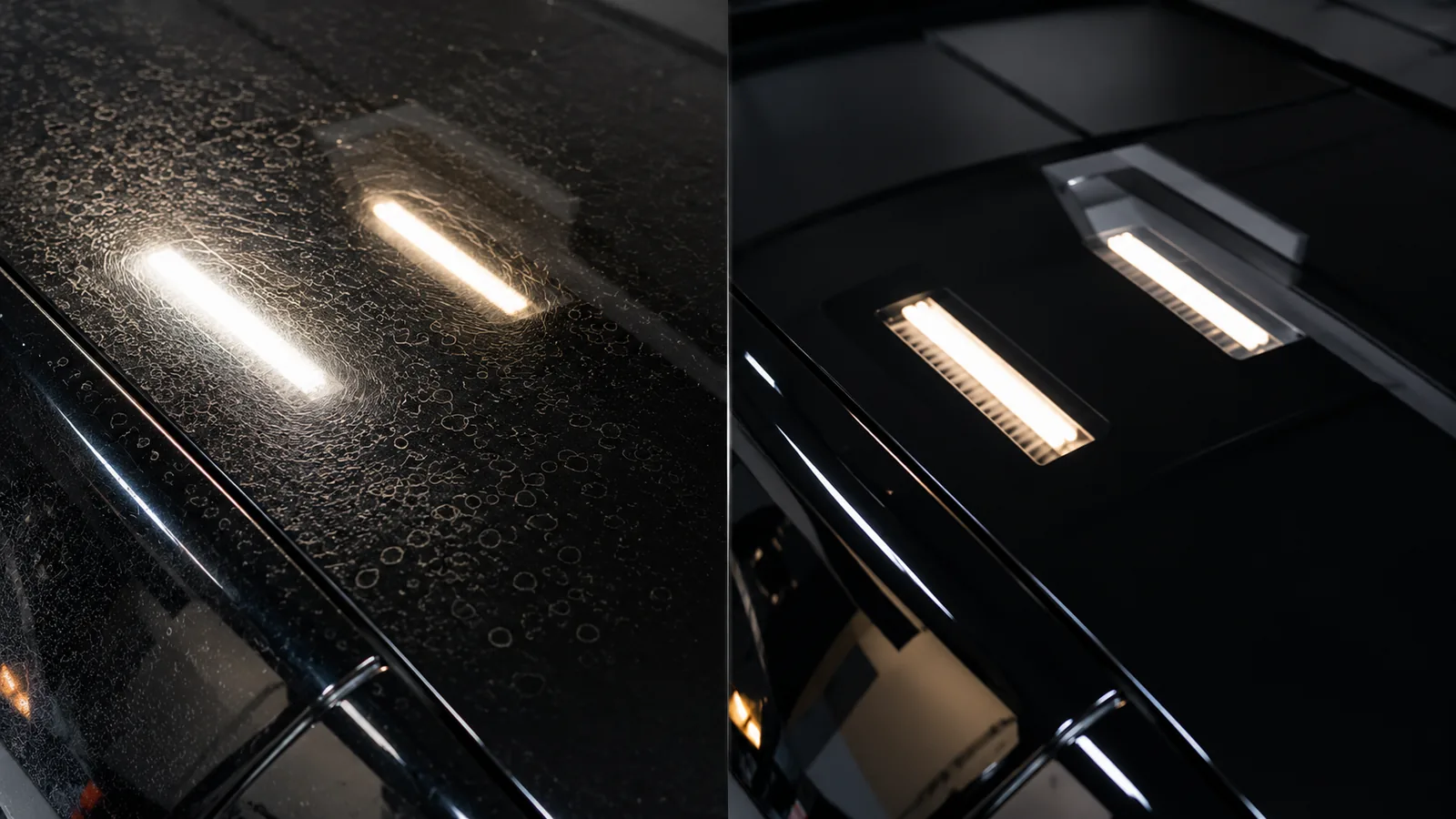
Type I water spots are superficial surface deposits. They occur when the mineral residue sits strictly on top of the clear coat surface without penetrating the resin layer. When you run your finger over a Type I spot, it feels slightly raised and rough, like a microscopic mineral crust. While Type I spots are visually annoying, they have not yet structurally altered the clear coat. However, if Type I deposits are exposed to direct sunlight and high humidity for more than 7 to 10 days along the lakefront, they rapidly evolve into destructive Type II damage.
Type II water spots represent genuine structural damage to your vehicle's paint. Calcium carbonate is inherently alkaline. When an alkaline mineral ring is heated repeatedly by the sun, it creates an aggressive acid-base chemical reaction that physically eats away, or "etches", into the clear coat polyurethane chains. When we inspect Type II spots under our digital paint microscopes, we do not see minerals sitting on top of the paint. We see tiny, crater-like valleys eaten directly into the clear coat resin itself.
If you wash a car with Type II damage, the paint surface might feel smooth to the touch, but under light, you will see thousands of dull, white, ring-shaped craters. The light reflecting off your car is scattered in every direction instead of bouncing back cleanly, making the vehicle look cloudy, hazy, and permanently aged regardless of how clean it actually is.
Why DIY Vinegar and Alkaline Wash Soaps Fail
When drivers notice water spots on their hood after a beach weekend, their first instinct is usually to consult internet forums or try DIY tricks. On our shop floor, we frequently have to fix vehicles that were severely damaged by these well-intentioned home remedies. Proper paint correction is what actually levels a damaged clear coat.
The most common advice on the internet is to pour household white vinegar over the car. The logic seems sound: vinegar is acetic acid (pH ~2.5), and calcium carbonate is alkaline, so the acid should theoretically neutralize the mineral. However, applying household vinegar to modern luxury paint is a major engineering mistake. Household vinegar is not chemically buffered for automotive finishes. Pouring raw acid over a hot clear coat breaks down the protective UV inhibitors built into your paint, leaving it vulnerable to rapid fading and premature failure.
On top of that, vinegar is completely ineffective on Type II etching. While vinegar can dissolve some surface-level calcium deposits, it cannot fill or level a physical crater eaten into the clear coat. You are applying raw acid to an already damaged clear coat without removing the crater walls. To make matters worse, vinegar instantly strips away any existing waxes or sealants, leaving bare, unprotected paint exposed to the harsh urban elements.
Taking your vehicle through a commercial drive-through car wash or using standard car wash soap at home is equally ineffective against late-summer water spots. Standard car wash soaps are formulated to be pH-neutral (pH 7.0) to safely remove loose dirt, road dust, and bug splatters. A pH-neutral soap lacks the chemical strength required to break the ionic bonds of baked-on calcium carbonate. You can scrub the vehicle for two hours with a wash mitt, and the mineral rings will remain completely untouched. Aggressively scrubbing water spots with a wash mitt rubs the hard mineral crust across your paint, inflicting thousands of deep, swirl-like scratches known as mechanical marring.
Comparative Performance Analysis
To understand why professional restoration is mandatory for surviving Chicago's late-summer environmental threats, examine how various treatment methods compare across key protective and technical metrics:
| Technical & Protective Metric | Standard Drive-Thru Wash | Household Vinegar / DIY Polish | Carrectly Acidic Decontamination & 9H Ceramic Shield | | - | - | - | - | | Type I Mineral Removal | Extremely Poor (0–10% removal) | Moderate (Removes surface calcium only) | 100% Elimination via chemical dissolution | | Type II Crater Leveling | None (Cannot repair clear coat) | None (Leaves physical craters intact) | 100% Restoration via multi-stage paint correction | | UV Radiation Defense | Zero protection | Strips protection, accelerates UV damage | Extreme UV-blocking barrier (SPF 1000 equivalent) | | Hydrophobic Water Beading | Poor (Water sheets and pools on paint) | Non-existent (Leaves surface raw and porous) | Extreme Hydrophobicity (110°+ water contact angle) | | Chemical Resistance | Fails against pH 3–11 acids/alkalines | Fails completely | Permanent resistance to pH 2–12 chemicals | | Longevity of Finish | 1 to 3 days | 0 days (Requires immediate re-protection) | Multi-year structural durability |
Protect Your Paint Before Fall Rains Set In
Don't let Lake Michigan minerals permanently etch your clear coat. Restore your mirror gloss today.
Claim Your Paint Protection Quote
The Carrectly Restoration Protocol: Step-by-Step Precision
You cannot fix chemical etching with a bucket of soapy water in your driveway. Reversing the damage inflicted by Lake Michigan’s microclimate requires industrial chemistry, precision machinery, and master craftsmanship. When a vehicle arrives at our climate-controlled Grand Ave facility, our technicians execute a rigorous four-stage restoration and armoring protocol.
1. Acidic Chemical Decontamination
Before we touch the vehicle with any mechanical tools, we must dissolve the mineral bonds chemically. We apply a specialized, automotive-grade acidic decontamination solution (pH ~3.0) specifically engineered to dissolve calcium carbonate and magnesium without harming polyurethane clear coat resins. This chemical foam penetrates deep into the paint pores, breaking down the ionic bonds of the mineral deposits and turning the hard crust into a soluble liquid that safely rinses away without scratching the paint.
2. Mechanical Clay Bar Decontamination
Even after chemical mineral dissolution, microscopic industrial fallout, brake dust, and tree sap remain embedded in the clear coat. Our technicians glide a premium synthetic clay bar across every exterior panel using a high-lubricity mist. The clay bar physically shears off any lingering microscopic surface contaminants, resetting the clear coat surface to an absolute state of smooth perfection.
3. Multi-Stage Dual-Action Paint Correction
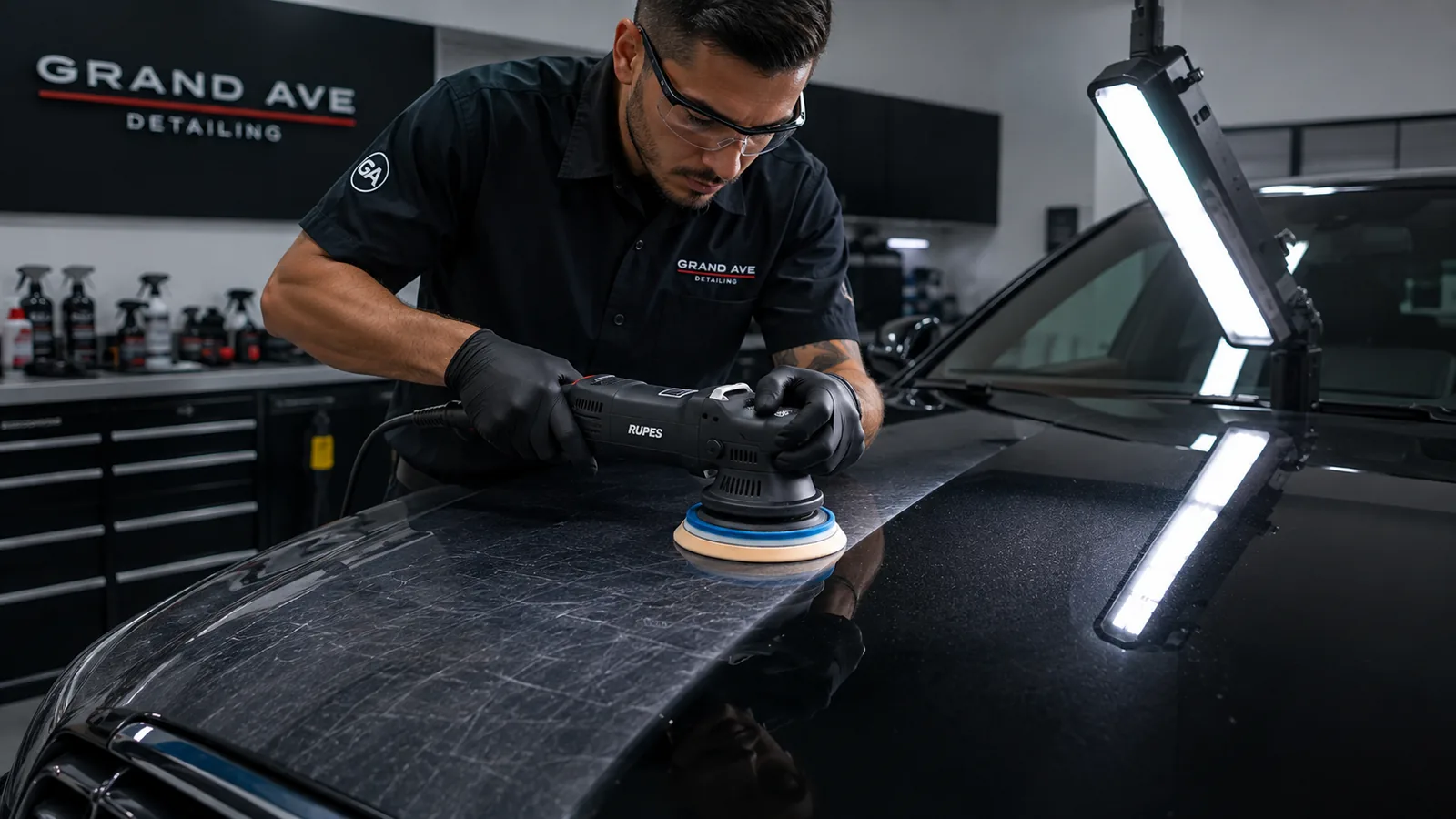
To eliminate Type II sub-surface craters and cloudy oxidation, we must mathematically level the clear coat surface. We start by using ultrasonic paint depth gauges to measure the exact thickness of your clear coat in microns, ensuring we leave maximum clear coat material on the vehicle for long-term structural integrity.
Using professional dual-action (DA) orbital polishers paired with diminishing micro-abrasive compounds, our technicians carefully shave away the damaged, micron-thin top layer of clear coat containing the water spot craters. We follow the heavy cutting phase with a fine finishing polish and ultra-soft foam pads. This restores 100% of the paint's original depth, clarity, and mirror-like gloss, eliminating all haze and swirl marks.
4. 9H SiO2 Ceramic Shield Application
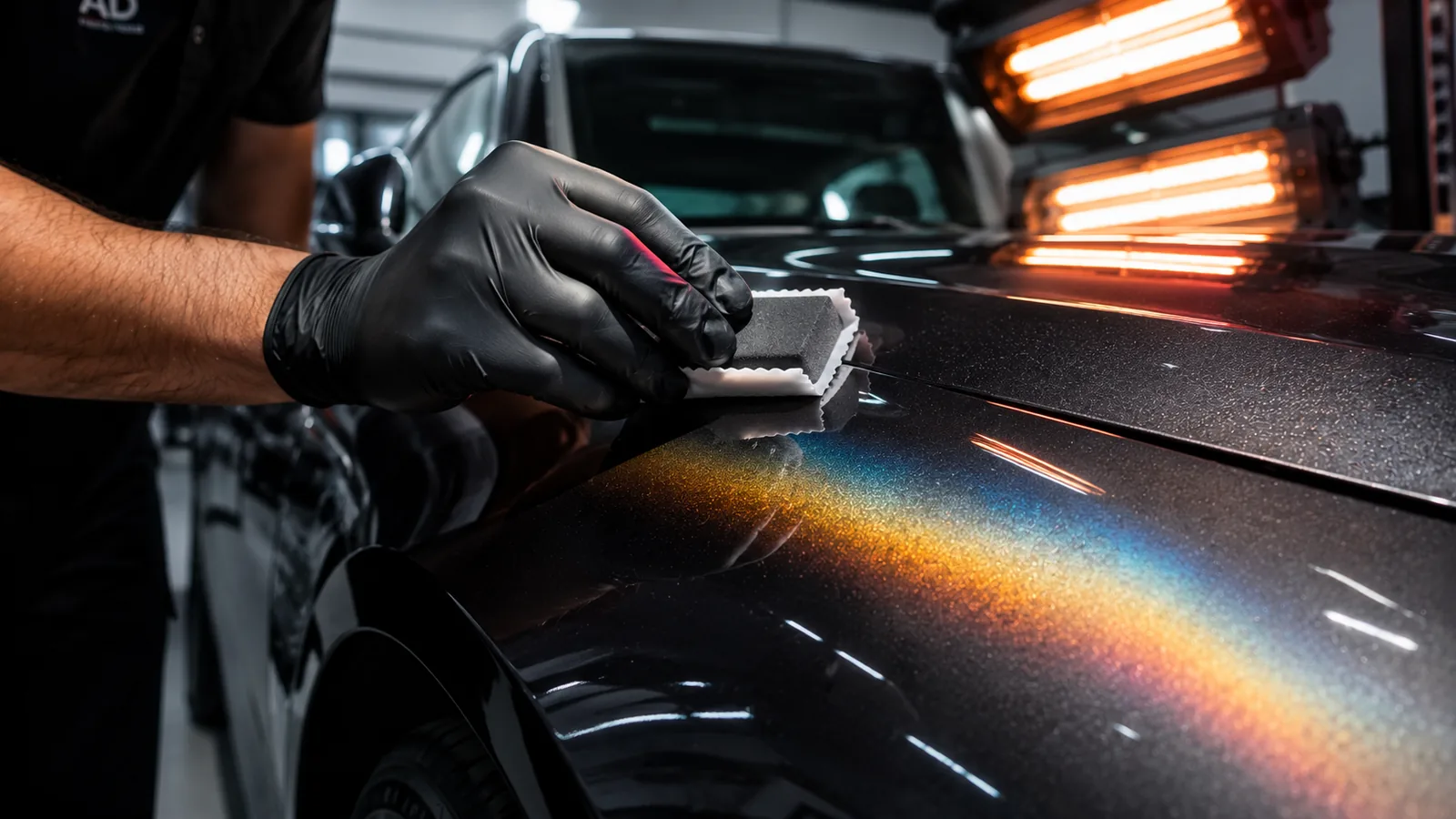
Once the paint is completely leveled and surgically clean, we must armor it against future lakefront exposure. Applying a standard wax is useless; carnauba wax melts at 160°F and washes off within weeks. Our ceramic coating guide covers that difference in depth. We apply a professional-grade Silicon Dioxide (SiO2) 9H Ceramic Coating by hand in small, overlapping sections. The liquid ceramic reacts with ambient moisture and forms a permanent covalent bond with the clear coat molecules.
Once fully cured under our infrared baking lamps, the ceramic coating turns into an ultra-hard, non-porous glass barrier. This barrier provides two essential defenses:
-
**Extreme Hydrophobicity: **Water contact angles exceed 110 degrees. Water droplets cannot sit flat on the paint; they form tight spheres that roll right off the car, taking surface dust and lake spray with them in a continuous self-cleaning action.
-
**Chemical Immunity: **The cured SiO2 glass layer is chemically inert between pH 2 and pH 12. If Lake Michigan water spray or sprinkler water lands on the car, the minerals cannot penetrate or etch the glass barrier. They simply sit on top, ready to be wiped off effortlessly with a microfiber towel.
Why Gold Coast & Lincoln Park Drivers Rely on Carrectly
We have outlined the science behind water spot damage and our industrial restoration process. Now let’s address the most significant obstacle every Chicago luxury car owner faces: time, logistics, and residential restrictions.
If you live in a luxury high-rise condominium or townhouse in Gold Coast, Lincoln Park, Streeterville, or River North, you face an insurmountable operational problem. Virtually all high-rise parking garages in downtown Chicago strictly prohibit residents from washing, detailing, or working on vehicles in their assigned spots due to EPA wastewater runoff laws and building insurance liabilities. Subterranean garages are dark, dusty, and lack access to clean water spigots or high-voltage power outlets required for professional paint correction tools. On top of that, as an executive, business owner, or busy professional, you do not have two hours to drive across the city, sit in a loud, uncomfortable waiting room at a traditional detailing shop, or coordinate complicated rideshare trips back to your office.
Carrectly Auto Care was engineered specifically to solve this urban friction. We provide an invisible auto care experience centered around our proprietary pickup and delivery logistics:
-
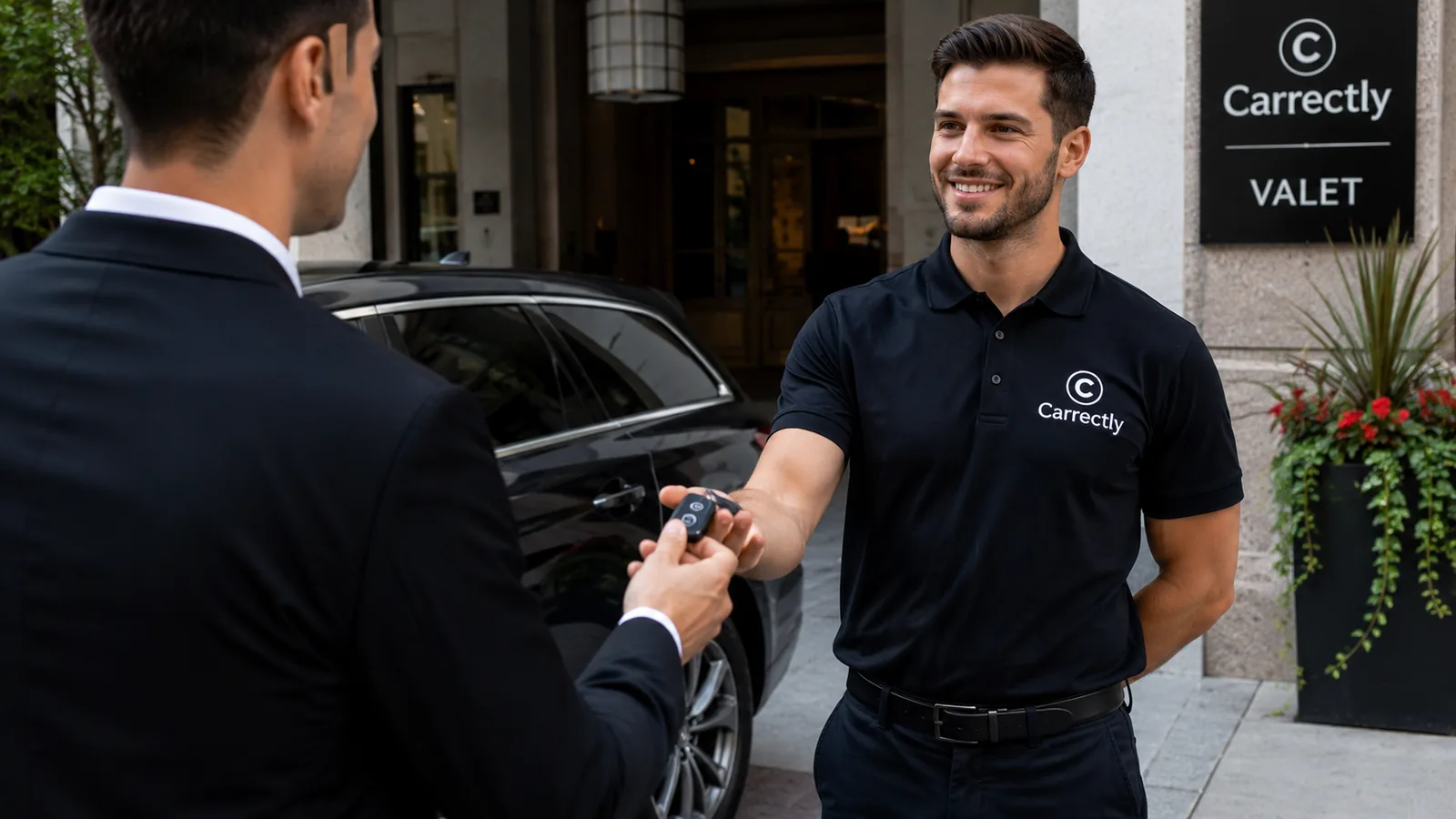
Effortless Key Handoff: Whether your car is parked on the 3rd subterranean level of a Streeterville high-rise or in the driveway of a Lincoln Park home, our fully insured professional drivers meet you or retrieve the keys directly from your building’s concierge desk.
-
**Controlled Transport: **We transport your vehicle safely to our secure, climate-controlled facility at 3069 W Grand Ave. Here, under controlled lighting, temperature, and dust-free conditions, our master technicians perform the multi-stage paint correction and ceramic curing process that is physically impossible to execute in a residential garage.
-
**Flawless Return: **Once the vehicle is completely restored, cured, and inspected, we deliver it back to your exact parking spot, sparkling, fully armored, and ready for your evening drive. You never lose a single minute of your workday or weekend.
Zero Driving. Zero Waiting Rooms. Total Protection.
Our insured drivers retrieve your vehicle directly from your downtown garage.
Calculate My Concierge Restoration Cost
Frequently Asked Questions
1. Can a professional ceramic coating completely stop water spot etching on cars parked near Lake Michigan?
Yes, a professional 9H Silicon Dioxide (SiO2) ceramic coating is the definitive defense against lakefront mineral damage. Water spot etching occurs when minerals invade the porous structure of standard clear coat polyurethane. A ceramic coating seals those pores with a non-porous glass layer that is chemically inert to pH levels between 2 and 12. Minerals from lake water spray or lawn sprinklers cannot bond to or etch the glass shield; they sit on the hydrophobic surface and can be wiped away effortlessly during a standard maintenance wash.
2. What is the difference between a water spot that can be washed off and one that requires paint correction?
A water spot that can be washed off is a Type I surface deposit, a dry ring of calcium and magnesium sitting on top of the clear coat. A water spot that requires paint correction is a Type II sub-surface etching, a physical crater eaten into the clear coat resin caused by heat and chemical reaction. If you wash your car thoroughly and can still see the outline of the water spot rings under direct light, you have Type II etching that requires dual-action machine polishing to level the surrounding paint.
3. Why shouldn't I just use household vinegar to remove water spots from my luxury car?
Household vinegar (acetic acid, pH ~2.5) can dissolve light, surface-level calcium deposits, but it presents serious risks to luxury vehicle finishes. Raw vinegar is unbuffered and can strip existing protective waxes, dull clear coat gloss, and accelerate oxidation on bare metal trim or rock chips. On top of that, vinegar cannot level physical Type II craters eaten into the clear coat. Professional restoration requires chemically buffered mineral removers followed by machine polishing to physically level the cratered paint surface.
4. How long does a multi-stage paint correction and ceramic coating process take at Carrectly?
Because a true restoration requires chemical decontamination, mechanical claying, ultrasonic paint depth measuring, precision dual-action polishing, hand-application of SiO2 ceramic coatings, and infrared curing time, the process typically takes 24 to 48 hours at our Grand Ave facility. However, because our concierge service handles all vehicle transport to and from your location, this extensive multi-day process occurs entirely in the background without affecting your personal schedule.
5. Is your concierge driver service fully insured while transporting my car between my garage and Grand Ave?
Yes, completely. Total safety, transparency, and peace of mind are the foundations of our concierge business model. From the exact second our professional driver takes possession of your keys in your Gold Coast, Lincoln Park, or Streeterville garage until your vehicle is parked safely back in its spot, your car is covered under Carrectly's multi-million-dollar Garage Keepers and commercial transport insurance policies. Your personal insurance policy is never involved.
6. Does parking in an underground high-rise garage protect my car from UV paint oxidation?
Underground garages protect your vehicle from direct sunlight while parked, but they create a different hazard. Subterranean garages trap dampness and high humidity while lacking natural ventilation. If you park your car in an underground garage while it is still covered in warm Lake Michigan water spray or road salt mist, the trapped moisture keeps the minerals active in your paint pores for days. Combining high-rise garage storage with lakefront driving makes professional ceramic coatings even more critical.
7. Can I wash my ceramic-coated car in a drive-through automatic car wash near downtown Chicago?
We strongly advise against taking a ceramic-coated vehicle through automated car washes, especially soft-cloth washes, which use abrasive brushes coated with dirt from previous vehicles that will scratch your paint. Even touchless automatic washes use extremely harsh, highly alkaline soaps (pH 12+) designed to strip dirt without brushes. While these harsh chemicals won't instantly destroy a 9H ceramic coating, repeated exposure will degrade the coating's hydrophobic top-layer over time. We recommend professional hand washes or utilizing Carrectly's maintenance detailing services.
8. Will applying a ceramic coating to fix water spots affect my leased luxury vehicle?
Applying a ceramic coating will significantly benefit your lease return process. Dealerships conduct strict end-of-lease inspections and regularly penalize lessees hundreds or thousands of dollars for "excessive paint wear," including heavy water spot etching, bird dropping damage, and severe swirl marks. A ceramic coating preserves the factory paint beneath in pristine condition. When your lease ends, the vehicle will pass paint inspection with flying colors, saving you money on lease-turn-in penalties.
Reclaim Your Time. Restore Your Vehicle.
Our fully insured concierge drivers retrieve your car directly from your Gold Coast, Lincoln Park, or Streeterville garage, perform master restoration at our Grand Ave facility, and return it flawlessly.
Book Concierge Pickup or call/text (773) 800-9085
Facility: 3069 W Grand Ave, Chicago, IL 60622
- ceramic coating
- paint correction
- paint restoration
- chicago
- exterior detailing