
Post-Summer Interior Reset: Deep Sanitizing & Leather Care
Remove sunscreen stains, beach sand & odors after summer trips. Get deep 210°F steam cleaning & leather conditioning via Carrectly's Chicago concierge pickup!
- September 30, 2026
- Carrectly Auto Care
- 13 min read
By the Senior Shop Foreman at Carrectly Auto Care (3069 W Grand Ave, Chicago, IL)
Summer road trips leave vehicle interiors embedded with abrasive beach sand, spilled sugary drinks, and chemical sunscreen oils that dissolve polyurethane leather topcoats. Standard quick-lube vacuums fail to extract deep carpet grit or restore stained leather pores. Carrectly Auto Care executes full cabin restoration using 210°F commercial steam extraction, pH-balanced leather pore conditioning, and industrial Ozone sterilization at our W Grand Ave facility, retrieved and returned via our door-to-door concierge pickup service.
The Post-Summer Interior Chaos: A Seasonal Cabin Crisis
On our shop floor at 3069 W Grand Ave, late August and September mark a busy transition period. As families return from summer road trips across the Midwest and executives prepare for the surge of autumn business trips into Fulton Market and The Loop, vehicles arrive at our facility facing a shared internal crisis. Months of intense summer activity leave cabin interiors biologically, aesthetically, and chemically exhausted.
To the average driver, a dirty interior after summer simply looks like a messy cabin requiring a quick vacuuming and a damp cloth wipe-down. However, as the Senior Shop Foreman at Carrectly Auto Care, I evaluate interior condition through the strict principles of chemical degradation, textile science, and microbial hygiene. What sits inside your vehicle's carpets and leather pores after late summer is far more damaging than loose dust.
Throughout June, July, and August, passengers track in kilograms of fine abrasive beach sand from Lake Michigan shorelines. Children spill sugary ice creams and organic juice boxes into seat crevices, while drivers transfer high concentrations of chemical sunscreens, body oils, and sweat directly into natural leather seating surfaces. When ambient Chicago temperatures exceed 90°F, your car's sealed glass windows create a greenhouse effect, driving interior cabin temperatures past 140°F. This intense heat bakes these organic and chemical contaminants deep into leather pores and carpet backings. If left unaddressed as autumn approaches, closed windows and forced hot air from your heater will turn your cabin into a dark, warm incubator for persistent odors and rapid material decay.
The Chemical Threat of Sunscreen & Sweat on Automotive Leather
To understand why simple wipe-downs fail to clean modern vehicle seats, you must first understand the engineering structure of modern automotive leather. Unlike natural leather goods like luxury jackets or boots, the leather upholstery found in modern luxury sedans, SUVs, and performance vehicles is a multi-layered synthetic hybrid assembly. It consists of three distinct structural layers: a natural chromium-tanned animal hide base that provides tensile strength, a color pigment layer that gives the seat its factory shade, and a razor-thin transparent polyurethane topcoat sprayed over the pigment to protect the dye from UV fading and mechanical abrasion.
Sunscreen is essential for outdoor skin protection, but it acts as a severe chemical solvent when transferred onto automotive leather. Modern sunscreens contain active organic UV filters, such as Avobenzone, Oxybenzone, and Homosalate, suspended in synthetic oil bases, alongside mineral reflectors like Zinc Oxide or Titanium Dioxide. When a driver sits on leather seats with sunscreen applied to their arms or legs, the combination of body friction and 140°F greenhouse cabin heat triggers a destructive chemical reaction.
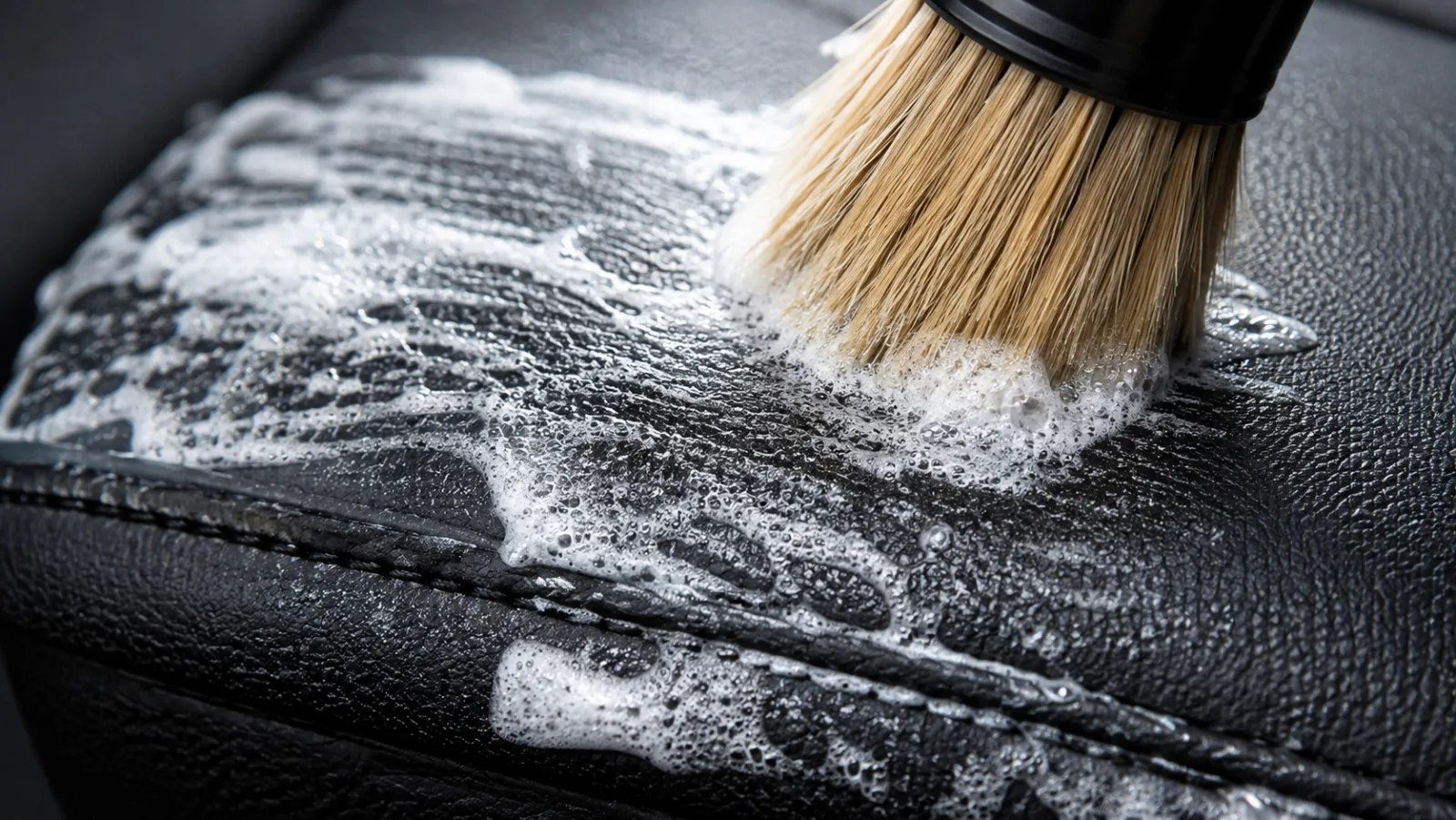
First, the synthetic oils in sunscreen dissolve the clear polyurethane topcoat, softening the protective layer and penetrating into the micro-pores. Next, white mineral particles like Zinc Oxide become trapped inside the softened, sticky polyurethane matrix, creating unsightly white, chalky stains on black or tan leather that cannot be wiped off with water. Finally, as the dissolved polyurethane dries and cools, it loses its elasticity and cracks. Every time you slide into the seat, the compromised topcoat flakes away, stripping the color pigment and exposing the raw, unprotected leather hide beneath.
Sand, Sugar, and Microbial Colonies in Vehicle Carpet Fibers
While chemical sunscreens destroy seating surfaces above, beach sand and sugary liquids work together to destroy carpet foundations below. Vehicle carpet is constructed from thousands of looped or cut synthetic nylon fibers woven into a primary rubberized backing. Beneath this carpet lies a thick, open-cell polyurethane foam pad designed to insulate the cabin from road noise and engine heat.
Beach sand gathered from trips to Michigan or Lake Michigan is composed of microscopic, sharp-edged quartz crystal fragments. When passengers step on carpet filled with sand, these sharp quartz crystals are pushed deep past the top fibers, settling directly at the carpet root where the fibers are glued into the backing. As passengers shift their feet while driving, the weight of their shoes grinds the sharp quartz grains against the base of the carpet fibers. The sand acts like millions of microscopic razor blades, severing the fiber roots over time and causing the carpet to thin out, shed fibers, and develop permanent bald spots that no vacuum can repair.
During summer road trips, spilled sugary soda, melted ice cream, and dropped food crumbs seep past the carpet weave and absorb directly into the underlying open-cell acoustic foam pad. In the high-humidity, high-heat environment of a closed vehicle, these trapped sugary organic residues create an ideal growth medium for bacterial colonies and fungal spores (Aspergillus, Cladosporium). The microbes digest the organic sugars, off-gassing stale, sour odors that penetrate every interior material. When you turn on your heater during cold Chicago autumn mornings, the forced air warms the sub-floor foam, releasing a heavy wave of stale, musty air into the breathing zone of your cabin. We break down that odor and allergen chemistry in more detail in our guide to eliminating interior odors, allergens and bacteria.
Why Quick-Lube Vacuums and DIY Retail Sprays Fail
When vehicle owners notice white sunscreen stains on their leather or musty smells in their carpets, their initial reaction is often to use drive-through quick-lube vacuums or purchase over-the-counter detailing wipes from auto supply stores. On our shop floor, we frequently undo the damage caused by these ineffective consumer products.
Drive-through car wash vacuums feature high-volume airflow, but they rely strictly on dry suction through broad plastic nozzles. They lack two essential mechanisms required for deep textile restoration: they cannot agitate or lift sand crystals wedged deep at the root of carpet backings, and they have zero liquid extraction capabilities, meaning they pass right over sticky, dried sugary residues embedded inside the sub-carpet foam.
Over-the-counter leather wipes and household sprays are formulated with harsh, low-cost surfactants or cheap silicone oils. Automotive leather requires a slightly acidic to neutral pH environment (pH 5.5 to 6.5) to maintain hide stability, whereas retail all-purpose cleaners are heavily alkaline (pH 9.0 to 11.0). Cleaning leather with alkaline cleaners strips natural moisture, leaving the hide stiff, brittle, and prone to cracking. On top of that, many retail leather conditioners contain cheap silicone emulsions that leave an oily, glossy finish. Factory automotive leather is designed to have a clean, smooth matte finish. Silicone coatings create a greasy surface that attracts dust, stains clothing, and makes the leather slippery and dangerous under hard braking.
Technical Performance Analysis
To understand why industrial cabin restoration is necessary after a heavy summer season, examine how various cleaning methods compare across key material and hygienic metrics:
| Cleaning & Restoration Metric | Drive-Thru Quick-Lube Vacuum | Retail Chemical Wipes & Sprays | Carrectly 210°F Steam & OEM Matte Conditioning | | - | - | - | - | | Deep Sand Extraction | Superficial (Removes surface dust only) | None (Cannot clean carpet roots) | 100% Elimination via high-lift extraction | | Sunscreen & Zinc Removal | None | Low (Smears white residue deeper into pores) | 100% Dissolution via pH-balanced steam cleaning | | Sub-Carpet Bacterial Destruction | None | None (Surface masking only) | Complete Sterilization (210°F steam + Ozone O3) | | Leather Surface Finish | N/A | Greasy, slippery high-gloss sheen | Restores factory-correct, smooth matte finish | | Chemical Safety & pH Balance | N/A | High risk (Alkaline formulas cause cracking) | 100% Safe (pH 5.5–6.5 engineered solutions) |
Don't Let Sunscreen Oils & Beach Sand Ruin Your Interior
Restore factory matte leather finishes and deep-clean carpet foundations before autumn.
Claim Your Interior Restoration Quote
The Carrectly Interior Restoration Protocol: Step-by-Step Precision
Restoring a cabin that has endured a Midwest summer requires specialized industrial equipment, precise chemical formulations, and trained craftsmen. When a vehicle enters our climate-controlled Grand Ave facility, our technicians execute a rigorous four-stage restoration protocol.
1. High-CFM Pneumatic Dry Extraction
Before introducing any liquids, we must remove all dry particulate matter. We use high-pressure pneumatic air whips to vibrate carpet fibers from beneath, forcing deeply embedded quartz sand crystals out from the backing up to the surface. Simultaneously, commercial dual-motor extraction vacuums with high cubic-feet-per-minute (CFM) airflow pull the loosened sand and grit out of the vehicle.
2. 210°F Commercial High-Heat Steam Extraction
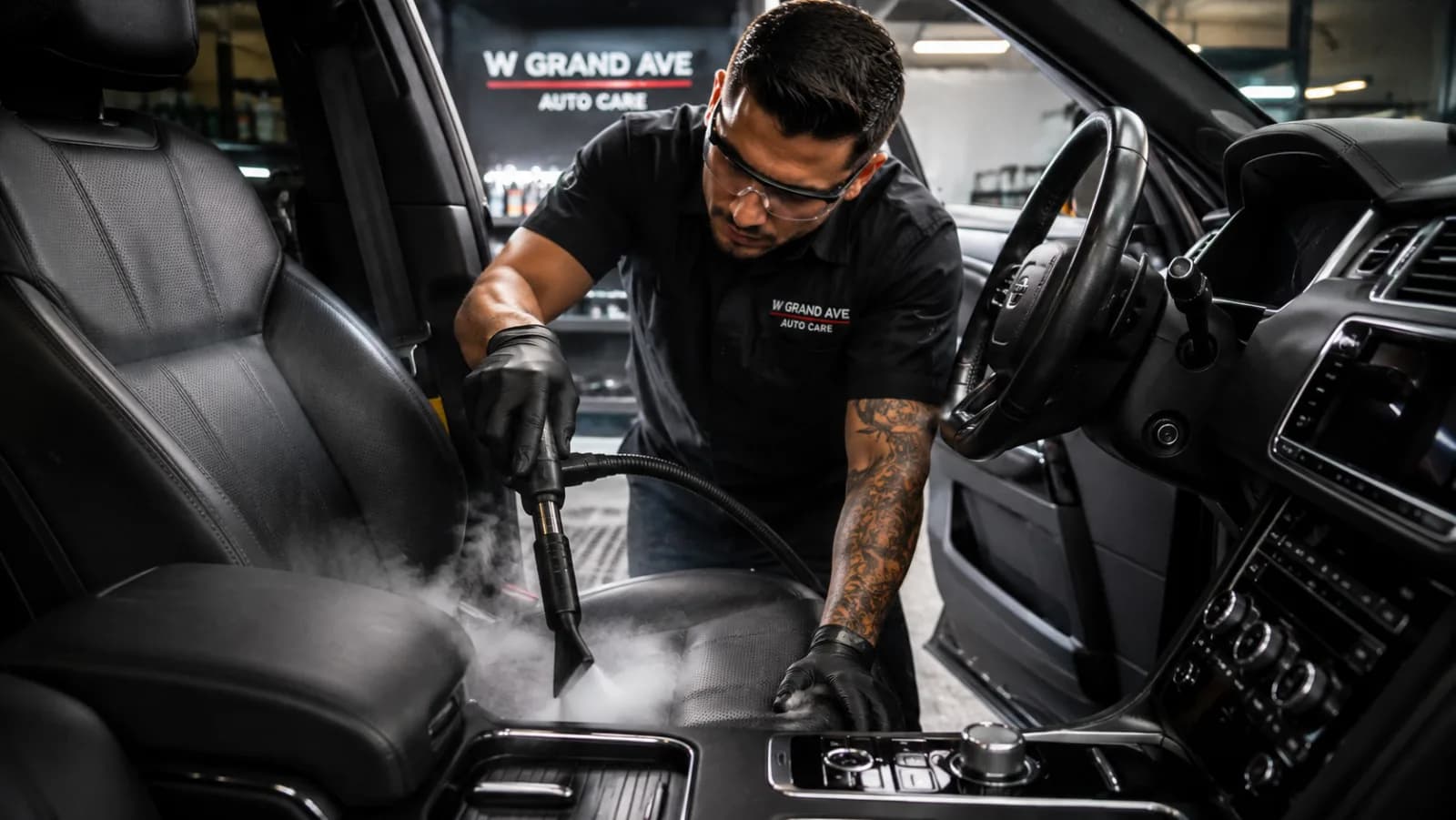
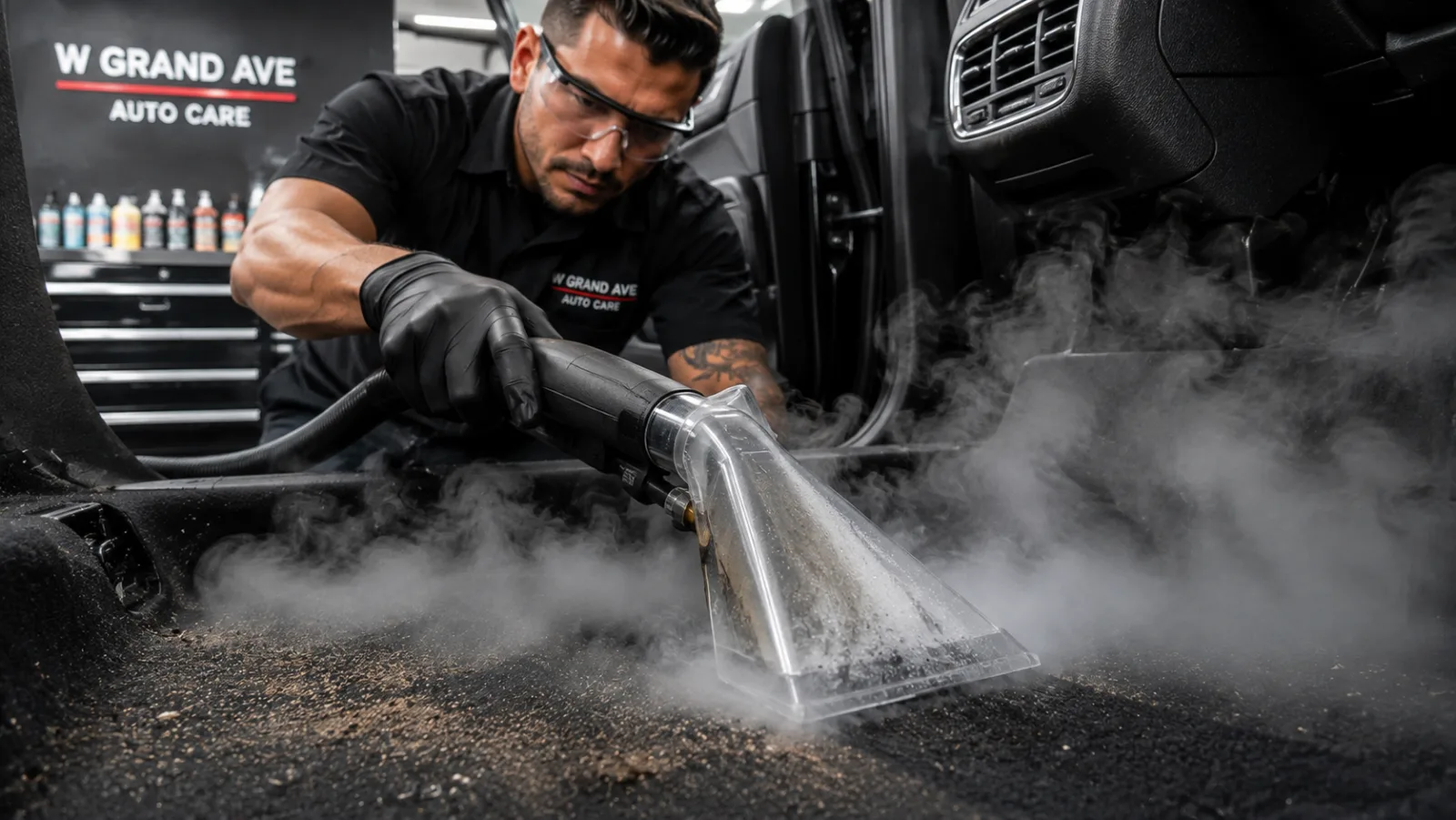
To eliminate sticky sugary residues, body oils, and stubborn stains without soaking the sub-carpet foam, we deploy commercial-grade thermo-steaming units that produce dry, low-moisture steam heated to 210°F at 90 PSI of pressure. This high-temperature steam vapor penetrates deep into carpet weaves and upholstery crevices. It instantly melts dried sugar crystals and emulsifies heavy sunscreen oils without oversaturating the carpet padding, while providing immediate antimicrobial sanitization that kills 99.9% of bacteria and fungal spores on contact. High-lift vacuum extraction tools immediately draw out the liquified contaminants and moisture, leaving fabrics clean, sanitized, and dry to the touch within hours.
3. pH-Neutral Leather Pore Cleansing and OEM Matte Conditioning
To safely remove white sunscreen stains from leather seating without stripping the color pigment, we use specialized pH-balanced (pH 6.0) leather cleansers paired with soft-bristle horsehair brushes. Our technicians work the cleanser into a fine, dense lather, gently lifting dissolved oils and zinc oxide particles out of the delicate polyurethane pores. Once the pores are surgically clean, we apply an OEM-grade, water-based leather conditioner containing rich amino acids and UV blockers. This nourishes the hide, restores natural flexibility, and leaves a beautiful, factory-correct non-greasy matte finish.
4. Industrial Ozone (O3) Cabin Decontamination
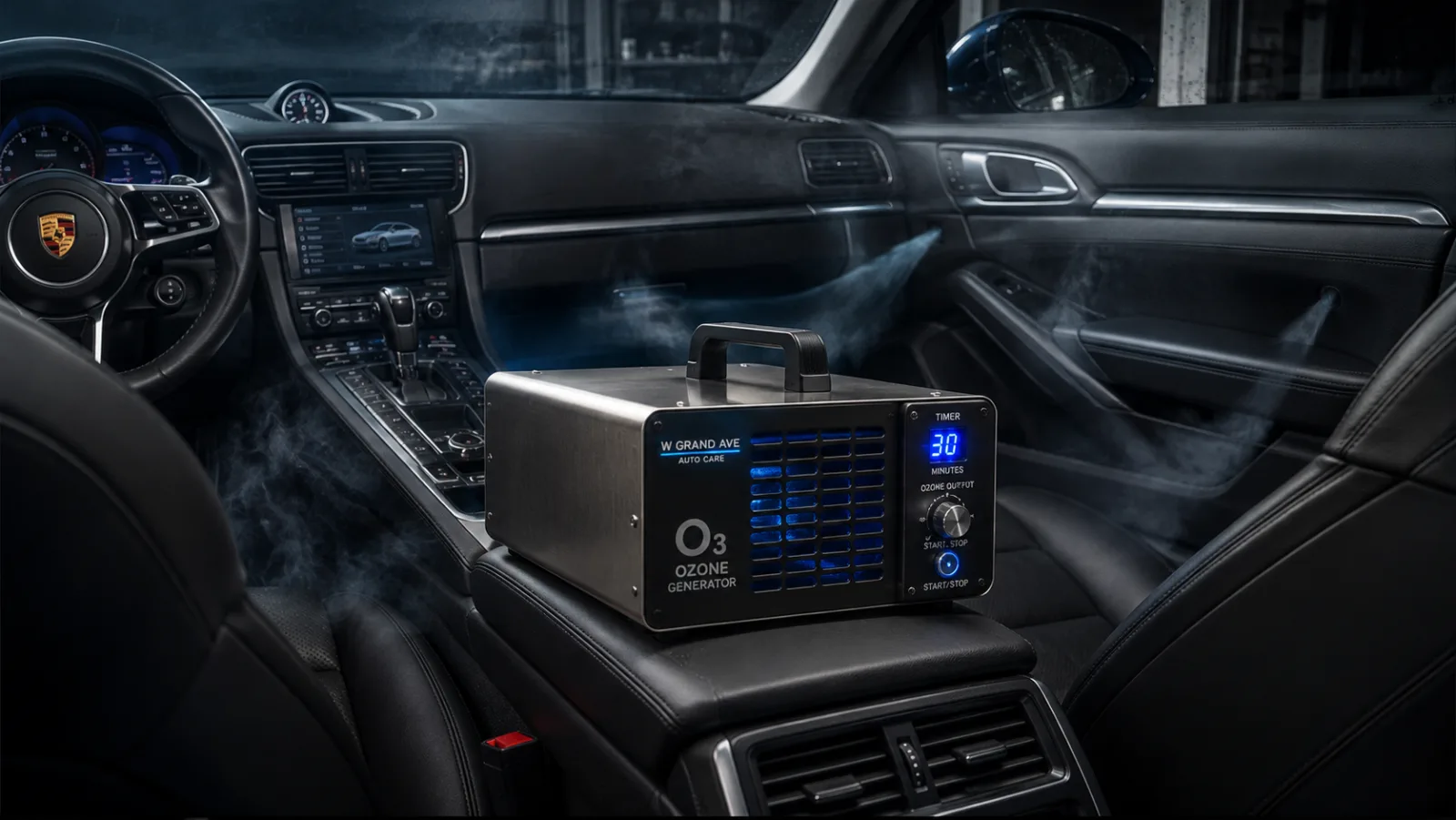
As the final phase of interior purification, we deploy an industrial Ozone (O3) generator inside the sealed vehicle cabin. Ozone gas permeates every interior material, flowing through seat foam, headliners, carpet backings, and climate control ductwork. Ozone acts as a powerful oxidizing agent, chemically shattering the cell walls of airborne mold spores, lingering smoke particles, and organic odor molecules. Once the treatment is complete, the O3 gas naturally reverts back into pure Oxygen (O2), leaving the cabin thoroughly sanitized, fresh, and free of artificial perfumes.
Why Chicago Drivers Need Carrectly
We have detailed the chemistry of leather topcoats, sand abrasion, steam extraction, and ozone decontamination. Now let's address the most significant hurdle facing busy Chicago car owners: busy family schedules, executive workdays, and lost time.
Think about what happens when you decide to get your vehicle's interior deeply detailed through traditional retail channels. You have to locate a reputable detailing shop and drive your car through heavy Chicago traffic to drop it off. You have to coordinate rideshare vehicles to get to your office in Fulton Market, your home in Naperville, or your school drop-off in Evanston. Then your car sits at the shop all day, forcing you to adjust your schedule, manage family logistics, and arrange another trip back to retrieve the vehicle before closing time. Most busy parents and executives simply do not have time for that friction. Our Chicago concierge auto service exists to remove it entirely. They continue driving in a dirty, contaminated cabin, allowing sunscreen oils to ruin their leather seats and sand to wear out their carpet fibers.
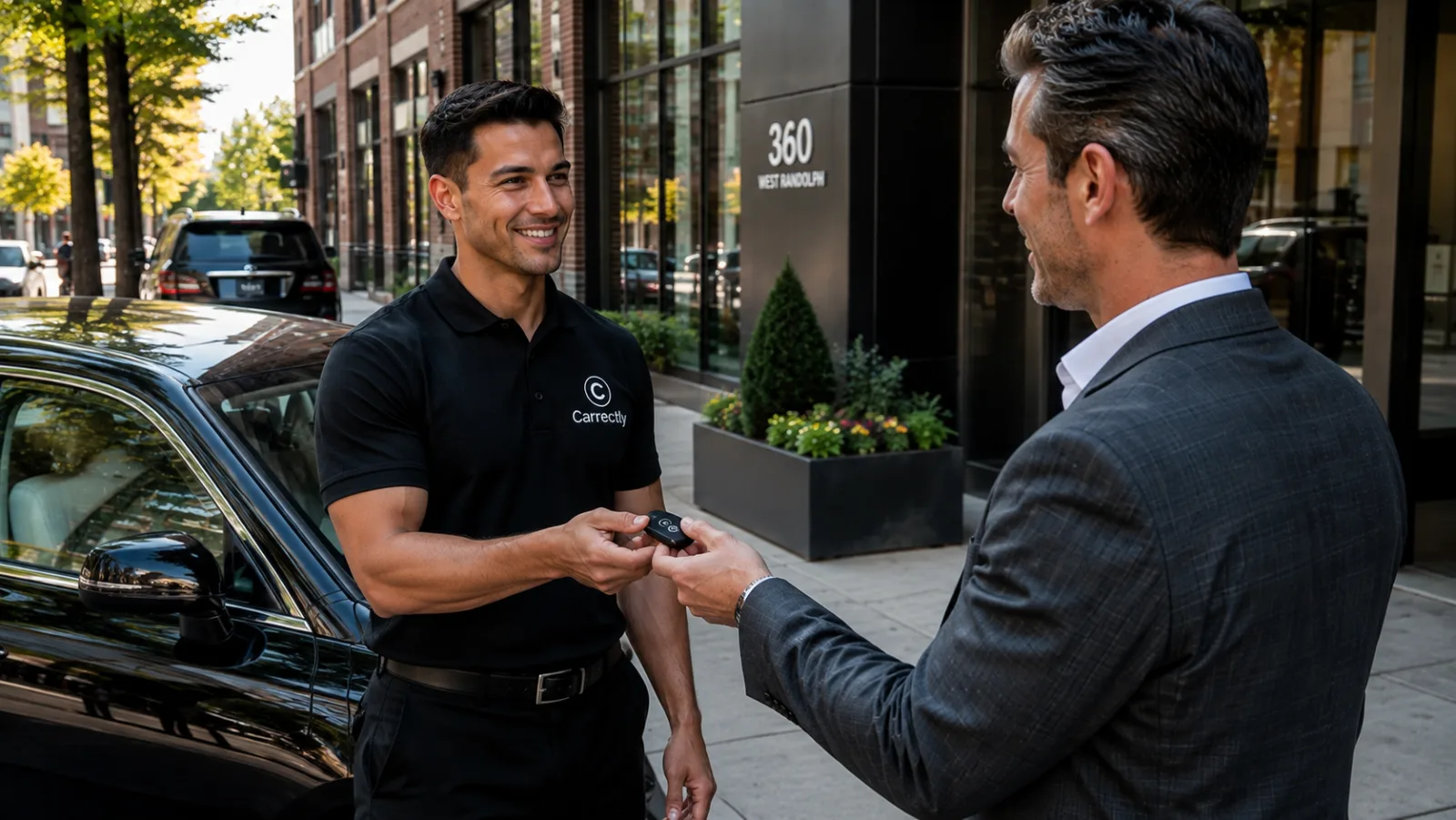
Carrectly Auto Care was engineered specifically to eliminate this operational friction through our invisible auto care experience centered around door-to-door pickup and delivery logistics:
-
Effortless Key Handoff: Whether your vehicle is parked in a subterranean high-rise garage in Streeterville, a condo driveway in Lincoln Park, or an executive parking spot in Fulton Market, our fully insured professional drivers meet you or retrieve the keys directly from your building's concierge desk.
-
Controlled Transport: We transport your vehicle safely to our secure, climate-controlled facility at 3069 W Grand Ave. Here, using commercial steam extractors, lift bays, and ozone generators, our master technicians perform the complete deep cleaning, leather restoration, and sanitization process.
-
Flawless Return: Once the interior is completely dry, sanitized, conditioned, and inspected, we deliver your vehicle back to your exact parking spot: clean, fresh, protected, and ready for your evening commute. You never lose a single minute of your workday or family time.
A Pristine, Sanitized Cabin with Zero Disruption to Your Schedule
Our insured drivers retrieve your vehicle directly from your Fulton Market, Lincoln Park, or Streeterville garage.
Calculate My Concierge Interior Detailing Cost
Frequently Asked Questions
1. Can white sunscreen stains on black leather seats be permanently removed without damaging the color?
Yes, provided the proper chemical process is used. Sunscreen stains appear white because mineral particles like Zinc Oxide become trapped in dissolved topcoat pores. Using our pH-balanced leather cleansing lather paired with 210°F low-moisture steam, we dissolve the synthetic oils holding the mineral particles, allowing us to safely brush the zinc oxide out of the pores without stripping the underlying color pigment.
2. How long does it take for my car's carpets to dry after a commercial steam extraction service?
Because our industrial steam extraction equipment uses superheated dry vapor (210°F at 90 PSI) combined with high-lift vacuum extraction, we inject minimal water into the fabric. The carpet surface and underlying foam dry completely within 2 to 4 hours. By the time our concierge driver returns your vehicle to your garage, the interior is clean, dry, and ready for immediate use.
3. Will the Ozone (O3) treatment leave a strong chemical odor inside my car?
No. Ozone is an unstable gas molecule that performs a natural oxidation reaction and then rapidly breaks down. Once our industrial generator completes its cycle, the O3 gas reverts back into pure Oxygen (O2) within 30 to 45 minutes. It leaves zero chemical residue, zero oily films, and zero artificial fragrances, just a clean, completely neutral, and sterile cabin atmosphere.
4. Why do my leather seats look shiny and greasy, and can you fix them?
Factory automotive leather is designed to have a smooth, non-reflective matte finish. Leather becomes shiny and greasy over time due to a buildup of body oils, sweat, dirt, and cheap silicone-based retail conditioners. Our deep cleansing protocol removes these greasy surface layers, stripping away dirt buildup and restoring your leather to its original, supple factory matte appearance.
5. How often should a family SUV or executive commuter car undergo deep interior sanitization in Chicago?
We strongly recommend a full interior deep cleaning and leather restoration twice a year in Chicago. Executing a deep sanitization in late summer (August/September) removes accumulated sand, sunscreen, and road trip spills before winter. A second service in early spring removes salt residue and winter grime, preserving your vehicle's resale value and indoor air quality year-round. Our salt and moisture decontamination guide covers that winter half of the cycle.
6. Is your concierge driver service fully insured while transporting my vehicle to W Grand Ave?
Yes, completely. Total safety, transparency, and peace of mind are the core foundations of our concierge business model. From the exact second our professional driver takes possession of your keys until your vehicle is parked safely back in its space, your car is covered under Carrectly's multi-million-dollar Garage Keepers and commercial transport insurance policies. Your personal insurance policy is never involved.
7. Can your steam extraction process safely remove tough stains from perforated leather seats?
Yes. Perforated leather seats, commonly found in vehicles equipped with heating and cooling ventilation, require extra care so liquids do not pool inside the ventilation holes and ruin underlying heating elements. Our technicians use dry vapor steam and controlled vacuum extraction to lift stains out of perforations safely without forcing moisture down into the electrical seat components beneath.
8. Will deep interior detailing help maintain the resale or trade-in value of my leased luxury car?
Unquestionably. Interior condition is one of the primary factors evaluated during lease return inspections and trade-in appraisals. Permanent leather discoloration, ground-in carpet stains, and lingering odors can trigger thousands of dollars in lease return penalties or drastically reduce dealer trade-in offers. Professional interior restoration preserves cabin materials in pristine condition, ensuring you avoid lease turn-in fees and command maximum trade-in value.
Reset Your Cabin Environment. Protect Your Vehicle's Value.
Insured concierge drivers collect your car from your home or office garage, run deep 210°F steam sanitization and leather conditioning at our Grand Ave facility, and return it dry and fresh.
Book Concierge Pickup or call/text (773) 800-9085
Facility: 3069 W Grand Ave, Chicago, IL 60622
- ozone treatment
- leather restoration
- steam cleaning
- chicago
- interior detailing